
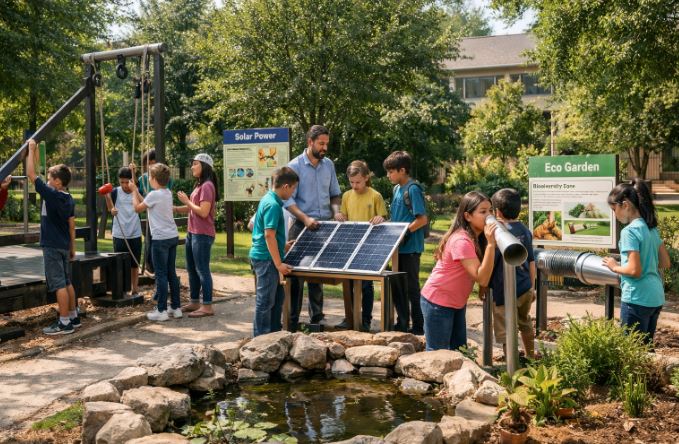
A science park in a school is more than a “cool lab area”, it’s a living learning environment that turns curiosity into skill. When students can touch, test, build, and observe real-world science, learning becomes memorable and meaningful. A well-planned science park supports hands-on exploration across physics, biology, chemistry, astronomy, and environmental science.
It boosts engagement, improves conceptual understanding, and builds problem-solving habits early. For schools, it strengthens academic outcomes, enhances reputation, and creates a future-ready campus that inspires innovation, teamwork, and scientific thinking every single day.
1. Hands-on learning that improves real understanding
A science park gives students a place to learn by doing, not just by reading. Concepts like motion, energy, ecosystems, optics, and weather become easier when learners can see them in action. Instead of memorizing formulas, students experiment, measure, and observe patterns.
This is especially powerful for middle and high school learners who struggle to connect theory to reality. Science parks can include interactive models like pulleys, levers, sound pipes, solar panels, and mini biodiversity zones.
Teachers can align activities with the curriculum and use the park for demonstrations, projects, and assessments. Over time, students develop stronger conceptual clarity, higher retention, and confidence in STEM subjects.
2. Builds curiosity, creativity, and innovation culture
Science parks naturally spark curiosity because they invite students to ask “why” and “how.” When learners explore open-ended setups, like water flow systems, magnet stations, or plant growth experiments, they start thinking like young researchers.
This kind of environment encourages creativity because students can try ideas without fear of being wrong. Schools can use the park for innovation clubs, maker activities, science fairs, and challenge-based learning.
It becomes a hub where students build prototypes, test solutions, and learn from failures. Over time, students develop an innovation mindset: observe a problem, form a hypothesis, experiment, and improve. This culture carries into academics, competitions, and future careers, making the school a place where ideas are celebrated.
3. Supports interdisciplinary learning beyond science
A science park can support many subjects, not only science. Math comes alive through measurement, data collection, graphs, and geometry in real structures. Language skills improve when students document experiments, write reports, and present findings to peers.
Social studies and geography link well with environment zones, climate demonstrations, and sustainability models. Art and design can be integrated through model-building, signage design, and creative exhibits. Even physical education can connect through biomechanics, balance experiments, and motion-based activities.
This interdisciplinary approach makes learning richer and helps students understand that real-world problems don’t belong to one subject. For schools following NEP-style holistic education, a science park becomes a practical platform to deliver project-based learning and competency-based outcomes.
4. Improves student engagement and academic performance
When students enjoy learning, they participate more and perform better. Science parks create excitement because lessons feel like exploration, not lectures. Students who are usually quiet in class often become active when working with models and experiments.
Teachers can use the park to start a topic, reinforce a difficult concept, or revise through interactive activities. This variety breaks routine and increases attention span.
Engagement also reduces absenteeism during science activities and motivates students to prepare better. Schools that integrate hands-on learning often see improvements in conceptual tests, practical exams, and science project quality.
Over time, a science park can strengthen results in board practicals, Olympiads, STEM fairs, and competitive examinations by developing stronger foundations and scientific reasoning skills.
5. Enhances school branding and parent confidence
A science park is a visible, high-impact infrastructure investment that parents instantly understand. It signals that the school values modern education, skill development, and experiential learning. During admissions, campus tours, and annual events, the science park becomes a highlight that differentiates the school from competitors.
It also creates opportunities for media coverage, community events, and partnerships with local colleges or science organizations. A well-maintained park reflects strong school management and future-forward thinking. It can attract admissions, increase retention, and improve word-of-mouth reputation.
For schools in growing cities and towns, such learning spaces act like proof of quality. Parents feel confident that their child is learning in an environment that is interactive, safe, and aligned with real-world needs.
6. Promotes sustainability and environmental responsibility
Many science parks include green learning features like rainwater harvesting models, composting units, solar demonstrations, wind energy models, and biodiversity gardens. These installations teach students sustainability in a practical way.
Instead of only hearing about climate change, students can measure rainfall, observe soil cycles, track plant growth, and understand energy saving through real examples. This helps schools build environmentally responsible habits across the campus, waste segregation, water conservation, and green initiatives become part of student life.
Schools can also connect science park activities to eco-clubs, community clean-ups, and plantation drives. Over time, students develop respect for nature and learn to make responsible choices. This is not just education; it’s character-building that benefits society and the planet.
Conclusion
Investing in a science park is an investment in stronger learning outcomes and a more inspiring school culture. It turns classrooms into experiences and students into confident explorers who understand science through observation and practice.
Beyond academics, it improves creativity, communication, teamwork, and problem-solving. It also enhances the school’s identity as modern, innovative, and future-ready.
Whether through interactive physics models, eco-learning zones, or experiment corners, a science park creates daily opportunities for discovery. With thoughtful planning and curriculum alignment, it becomes a long-term asset that benefits students, teachers, parents, and the wider community.
FAQs
What is a school science park?
A science park is an outdoor or dedicated learning zone with interactive science models and experiment setups.
Is a science park expensive to build?
Costs vary based on size and models, but schools can start small and expand in phases. Many parks are modular, making them budget-friendly over time.
Which classes benefit most from a science park?
Primary students gain curiosity and basics, while middle and high school students gain deeper conceptual clarity. It’s useful across grades when activities are age-appropriate.
How can teachers use it in daily teaching?
Teachers can run demonstrations, practical lessons, projects, and assessments in the park. It also supports clubs, exhibitions, and STEM competitions.
How do schools maintain a science park?
Maintenance is simple with periodic checks, cleaning, and student involvement through clubs. Durable materials and clear usage rules make upkeep easy.Top of Form