
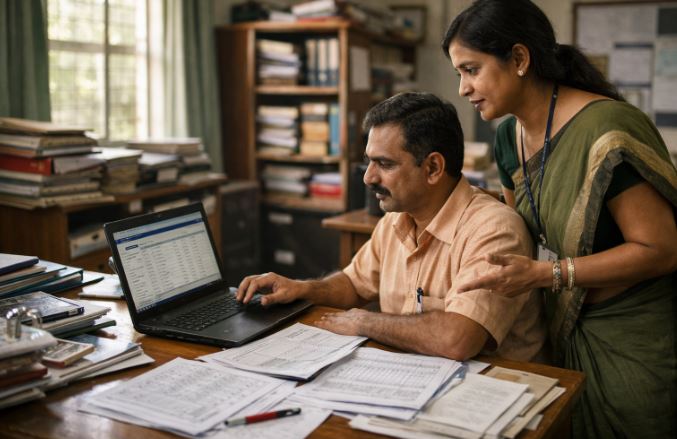
Schools today handle far more than attendance sheets and report cards. They manage continuous assessments, parent communication, subject wise progress, examination planning, and personalised academic support for every learner.
In this environment, student performance tracking ERP software has become an important tool for modern school management. It helps schools collect, organise, and analyse student data in one place so that teachers and administrators can take better decisions at the right time.
For Indian schools especially, where class strength is often large and academic expectations are high, manual tracking can create delays and errors. A digital ERP system makes performance records easier to update, review, and share. It gives schools a clearer view of how students are learning across exams, assignments, class activities, and attendance patterns.
This improves consistency, transparency, and timely intervention. When used well, student performance tracking ERP software supports not only academic growth but also better coordination between schools, teachers, students, and parents.
Why Do Schools Need Student Performance Tracking Systems Today?
Schools need student performance tracking systems today because teaching and evaluation have become more data driven and continuous. Traditional methods often depend on scattered records, handwritten notes, and separate files maintained by different teachers. This makes it difficult to see the full picture of a student’s academic journey.
A student may perform well in one subject, struggle in another, and show irregular attendance at the same time. Without a proper system, such patterns can be missed.
A performance tracking system helps schools bring all academic records together in one digital platform. This creates better visibility into marks, classroom participation, assessments, and progress over time. It also reduces dependence on manual calculations and repeated data entry. For school leaders, it becomes easier to identify performance trends across classes and sections.
For teachers, it saves time and improves reporting accuracy. For parents, it offers more confidence because updates are clearer and more organised. In a fast moving academic environment, schools need systems that support timely action and informed decisions.
How Does Student Performance Tracking ERP Software Help Schools?

Student performance tracking ERP software helps schools by creating a central platform for academic monitoring, evaluation, and communication. Instead of maintaining performance data in different files or separate tools, schools can use one system to record marks, attendance, assignment scores, behaviour observations, and exam outcomes. This improves accuracy and makes information easier to access when needed.
The software also supports quicker academic review. Teachers can compare student progress across terms and identify who needs extra support.
School management can assess overall class performance and monitor whether learning goals are being achieved. Parents can receive structured updates without waiting only for parent teacher meetings or final result days.
Some of the most useful outcomes include
- Better visibility of student progress
- Faster preparation of reports
- Easier communication with parents
- Stronger support for teachers
- More reliable academic planning
This makes the ERP not just an administrative tool but a practical academic support system for the entire school.
How Can School ERP Software Improve Academic Performance Monitoring?
School ERP software improves academic performance monitoring by turning student data into useful insight. When schools use manual records, teachers may only review performance at the end of a term. By then, valuable time may already be lost.
An ERP system allows regular monitoring through real time or periodic updates. This helps schools respond earlier when a student’s grades, attendance, or class engagement begin to fall.
Academic monitoring becomes stronger because the software can show trends rather than isolated marks. A student who performs inconsistently can be identified quickly. A subject with low average scores across multiple sections can also be flagged for attention. This helps school leaders plan interventions such as revision sessions, counselling support, or teaching strategy changes.
The system also brings more fairness to evaluation. Marks and remarks are stored systematically, which reduces confusion and supports transparent reporting. Teachers do not need to search through registers or spreadsheets to understand a student’s past performance. With better visibility and easier access to records, schools can move from reactive reporting to proactive academic support.
How Does a Student Performance Management System Support Teachers?
A student performance management system supports teachers by reducing administrative pressure and making student evaluation more organised. Teachers often spend a large amount of time recording marks, preparing reports, checking assessment history, and updating parent communication. When these tasks are done manually, they take away time from lesson planning and classroom support. An ERP system helps automate many of these routine processes.
Teachers can enter marks once and generate progress summaries without repeated formatting or calculations. They can view previous assessments, compare subject performance, and identify learning gaps with greater ease. This makes it simpler to plan remedial classes, group students by need, or adjust teaching strategies. The system also supports more consistent documentation, which is useful when multiple teachers handle the same class or subject area.
Another major benefit is clarity. Teachers can track how attendance, assignments, and exam results connect to overall performance. This helps them provide more meaningful feedback. Instead of giving only general observations, they can share specific academic patterns and suggestions. In this way, the software acts as a support tool that strengthens both classroom instruction and student guidance.
How Do Student Analytics Dashboards Help Schools Track Academic Progress?

Student analytics dashboards help schools track academic progress by presenting performance data in a simple and visual format. Large amounts of academic information can be difficult to interpret when stored only as raw numbers. Dashboards solve this problem by showing trends, comparisons, and summaries that are easier for teachers and administrators to understand quickly.
For example, a dashboard may display class wise averages, student wise progress, attendance linked with marks, or subject areas where improvement is needed. This helps schools move beyond basic score recording and toward meaningful analysis. Instead of asking only who passed and who failed, schools can ask deeper questions about consistency, subject difficulty, and student engagement.
A dashboard is especially useful during review meetings and planning sessions. It gives leadership teams a practical way to monitor outcomes across different classes and departments.
| Area tracked | How dashboards help |
| Exam performance | Shows score trends across terms |
| Attendance | Connects presence with academic outcomes |
| Subject analysis | Highlights strong and weak learning areas |
| Student comparison | Identifies who needs support or challenge |
| Class performance | Helps schools plan teaching improvements |
This kind of visual intelligence supports faster and better academic decisions.
How Can Automated Report Card and Grade Tracking Systems Improve Evaluation?
Automated report card and grade tracking systems improve evaluation by making assessment records more accurate, timely, and consistent. In many schools, report creation is one of the most time consuming academic tasks.
Teachers and office teams may spend hours collecting marks, checking totals, arranging comments, and preparing final records. Manual handling increases the risk of delays and calculation mistakes. Automation reduces these problems significantly.
When grades are entered into the ERP system, report cards can be generated using standard formats and approved criteria. This ensures that every student is evaluated through a structured process.
It also makes internal moderation easier because records are already stored in a central place. Schools can maintain better historical data and review past performance without searching through physical files.
This system is also valuable for communication. Parents receive clearer academic reports that are easier to understand. They can track how students are performing over time rather than seeing only final outcomes. For schools, this improves accountability and trust. Evaluation becomes not just faster, but more transparent and dependable for everyone involved.
How Does Education ERP Software Help Schools Make Data Driven Decisions?
Education ERP software helps schools make data driven decisions by turning routine academic records into useful planning insight. Many school decisions are connected to student performance, including remedial support, timetable changes, subject planning, teacher allocation, and parent engagement. Without organised data, such decisions may depend too much on assumptions or incomplete information. An ERP system provides a stronger evidence base.
School leaders can use academic data to identify patterns that may otherwise go unnoticed. They can review which classes need additional support, where performance is improving, and which areas require intervention. They can also study long term progress instead of looking only at one examination cycle. This is important for both academic quality and institutional growth.
Data driven decision making also encourages consistency. When schools rely on recorded evidence, decisions become more transparent and easier to justify. It supports better collaboration among principals, coordinators, teachers, and parents.
In the long run, this leads to smarter planning and improved student outcomes. Rather than simply storing information, the ERP helps schools use information in a purposeful and strategic way.
Conclusion
Student performance tracking ERP software has become a valuable part of effective school management. It helps schools organise academic records, monitor progress with greater accuracy, and respond to student needs at the right time.
From supporting teachers with easier reporting to helping school leaders make informed decisions, the software creates benefits across the whole academic system. It also strengthens communication with parents and improves confidence in school evaluation methods.
For schools in India that aim to balance quality education with efficient administration, such ERP solutions offer practical long term value. They do not replace teachers or academic judgement. Instead, they support them with better tools, better visibility, and better coordination.
As schools continue to focus on student outcomes and personalised support, a strong performance tracking ERP system can play an important role in building a more responsive and data aware learning environment.
FAQs
What features should schools look for in student performance tracking ERP software?
Schools should look for features such as marks entry, attendance integration, report card generation, parent communication, analytics dashboards, exam management, and role based access. A user friendly interface and reliable data security are also important.
How does ERP software simplify student report management in schools?
ERP software simplifies report management by storing assessment records in one place and generating standardised report cards automatically. This reduces manual work, improves accuracy, and helps schools share progress updates more efficiently.
Can student performance tracking ERP software integrate with other school systems?
Yes, many ERP systems can connect with attendance modules, fee management, timetable tools, communication portals, and learning related systems. This creates a more connected and efficient school management process.
Is student performance tracking ERP suitable for small and large schools?
Yes, it is suitable for both small and large schools. Small schools benefit from better organisation and reduced paperwork, while large schools benefit from centralised control, faster reporting, and easier performance analysis across many classes.
How does ERP technology improve transparency between teachers, parents, and school administrators?
ERP technology improves transparency by providing clear, timely, and structured academic updates. Parents can view progress more easily, teachers can share evidence based feedback, and administrators can monitor records without relying on fragmented information.