
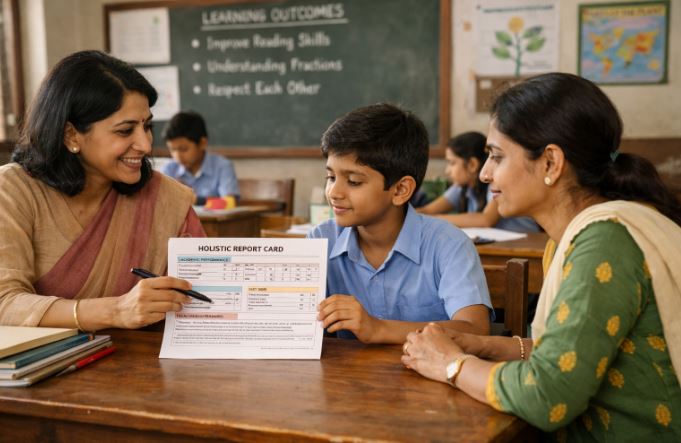
Assessment in Indian schools is undergoing a major transformation. With the introduction of the National Education Policy 2020, the focus has shifted from marks and rote memorisation to overall student development.
In this context, the holistic report card has emerged as a progressive tool that reflects not only academic performance but also skills, values, and competencies.
Unlike traditional report cards that mainly highlight exam scores, a holistic report card captures a 360 degree view of a learner’s growth. It considers cognitive abilities, social and emotional development, creativity, and practical skills.
Supported by CBSE and PARAKH NCERT frameworks, this approach is redefining how schools in India evaluate student progress in 2026 and beyond.
What Is a Holistic Report Card?
A holistic report card is a multidimensional progress document that evaluates students across cognitive, affective, and psychomotor domains. As described by CBSE and PARAKH NCERT, it is designed to provide a comprehensive picture of a learner’s growth.
The holistic progress card moves beyond subject wise marks. It includes observations on behaviour, participation, collaboration, creativity, and skill development. Teachers, peers, and even students themselves contribute to the evaluation process.
Key Elements of a Holistic Progress Card
The report generally includes:
- Academic performance based on competencies
- Life skills and social emotional learning
- Co curricular achievements
- Self assessment and peer feedback
- Teacher remarks and developmental suggestions
This structure ensures that the holistic report card captures a child’s personality, strengths, and areas for improvement in a balanced manner.
Why Is the Holistic Report Card Important Under NEP 2020?
The holistic report card plays a central role in implementing the vision of NEP 2020. The policy clearly states that assessment should promote learning rather than simply measure it. This shift is necessary because traditional examination systems often create pressure and do not fully represent a student’s potential.
Under NEP 2020, education focuses on competency based learning. Students are encouraged to develop critical thinking, creativity, communication skills, and ethical values. The holistic report card supports this vision by tracking progress across multiple domains instead of only academic marks.
Alignment with NEP Goals
The holistic progress card aligns with key objectives such as:
- Reducing exam stress
- Encouraging experiential learning
- Promoting continuous assessment
- Supporting individual learning pathways
By focusing on overall development, the holistic report card ensures that every child is assessed fairly and meaningfully. It reflects progress in real learning outcomes rather than memorised answers.
How Does the Holistic Progress Card Assess 360 Degree Student Development?
The concept of 360 degree assessment is central to the holistic report card. It means evaluating students from multiple perspectives and across different dimensions of learning.
Instead of relying only on written exams, the holistic progress card uses varied assessment methods such as classroom observations, project work, presentations, portfolios, and practical tasks. This approach allows teachers to understand how students apply knowledge in real situations.
Domains of Assessment
According to the framework shared by PARAKH NCERT, the assessment covers:
- Cognitive domain which includes understanding and application of concepts
- Affective domain which measures attitudes, values, and emotional growth
- Psychomotor domain which evaluates practical and physical skills
By integrating these domains, the holistic report card ensures that academic excellence is balanced with emotional intelligence and practical ability. This 360 degree system supports deeper learning and long term development.
What Are the Key Features of the CBSE Holistic Progress Card Framework?
The CBSE holistic progress card framework introduces structured and transparent evaluation methods. It provides clear descriptors and rubrics that help teachers assess competencies effectively.
One important feature is competency mapping. Each subject is linked to specific learning outcomes. Teachers assess whether students have achieved these outcomes through varied activities rather than only exams.
Notable Features
- Rubric based grading system
- Descriptive feedback instead of only marks
- Integration of co curricular activities
- Inclusion of self and peer assessment
- Continuous tracking of progress
The holistic report card also encourages schools to adopt digital platforms for maintaining student records. This improves transparency and helps parents stay informed about their child’s progress throughout the academic year.
How Does PARAKH NCERT Support Competency Based Assessment in India?
PARAKH, established by NCERT, plays a crucial role in standardising assessment reforms across India. It provides guidelines and frameworks for implementing the holistic progress card in schools.
The organisation focuses on creating assessment tools that measure real competencies rather than memorisation. It supports training programmes for teachers to help them understand how to design meaningful evaluations.
Role of PARAKH
PARAKH contributes by:
- Developing national assessment standards
- Providing model holistic progress card formats
- Ensuring alignment with NEP 2020
- Promoting evidence based evaluation practices
Through these efforts, the holistic report card becomes a reliable and structured system rather than a subjective evaluation method.
How Is the Holistic Report Card Different from Traditional Report Cards?
The difference between a holistic report card and a traditional report card is significant. Traditional systems mainly focus on marks obtained in periodic tests and final exams. They often ignore skills, creativity, and behaviour.
In contrast, the holistic progress card presents a complete learning profile. It documents strengths, interests, participation, teamwork, and emotional growth.
Comparison
| Aspect | Traditional Report Card | Holistic Report Card |
| Focus | Exam marks | Overall development |
| Assessment Type | Summative exams | Continuous and competency based |
| Feedback | Numeric scores | Descriptive feedback |
| Skills Evaluation | Limited | Cognitive, affective, psychomotor |
| Student Involvement | Minimal | Self and peer assessment included |
This shift ensures that students are recognised for diverse talents and not judged solely by examination performance.
What Benefits Does a Holistic Report Card Offer to Students, Teachers, and Parents?
The holistic report card creates value for all stakeholders in the education system. For students, it reduces fear of exams and builds confidence. It recognises individual strengths and encourages self reflection.
For teachers, it provides a structured framework to observe and record student progress more effectively. It also promotes innovative teaching strategies aligned with competency based learning.
Parents benefit from detailed insights into their child’s academic and personal development. Instead of seeing only marks, they understand behaviour patterns, interests, and growth areas.
Long Term Impact
- Encourages personalised learning
- Improves engagement and motivation
- Strengthens school home collaboration
- Supports career readiness and life skills
By offering a balanced and transparent evaluation system, the holistic report card contributes to a more inclusive and future ready education system in India.
Conclusion
The holistic report card represents a transformative step in Indian education. Guided by NEP 2020, CBSE, and PARAKH NCERT, it moves beyond marks and embraces a comprehensive approach to student assessment.
By evaluating cognitive, affective, and psychomotor domains, it ensures that every child’s potential is recognised and nurtured.
As schools continue to adopt this multidimensional framework in 2026, the holistic progress card is shaping a more balanced and meaningful evaluation system.
It not only measures what students know but also how they grow, interact, and apply their learning in real life. This shift marks a positive and necessary evolution in the Indian education landscape.
FAQs
How are cognitive, affective, and psychomotor skills practically measured in classrooms?
Teachers use projects, presentations, observations, and practical activities to assess these domains. Rubrics help measure understanding, behaviour, and hands on skills in a structured manner.
Is the holistic progress card compulsory for all CBSE affiliated schools?
CBSE has introduced the framework in alignment with NEP 2020, and affiliated schools are gradually implementing it as part of assessment reforms.
How does self-assessment benefit students in the holistic report card system?
Self assessment encourages reflection, responsibility, and awareness of strengths and weaknesses, helping students take ownership of their learning.
Can schools use digital platforms to manage holistic report cards?
Yes, many schools integrate digital school management systems to record competency based evaluations and share progress with parents.
How does the holistic report card reduce exam pressure?
By emphasising continuous assessment and multiple evaluation methods, it reduces dependence on one final exam and promotes consistent learning throughout the year.