In today’s fast-paced work environment, organizations need reliable and efficient ways to manage employee attendance. Traditional methods like manual registers or biometric systems often fall short in accuracy, hygiene, and scalability. A smart card based attendance solution offers a modern alternative by combining speed, security, and convenience.
With contactless technology and seamless integration capabilities, it enables businesses to streamline workforce management, reduce errors, and enhance operational efficiency while creating a more organized and transparent attendance system.
1. Enhanced Accuracy and Elimination of Proxy Attendance
One of the biggest challenges organizations face is inaccurate attendance tracking due to manual errors or proxy entries. Smart card based systems eliminate this issue by assigning a unique card to each employee, ensuring that attendance is recorded only when the authorized card is used. Unlike manual registers or PIN-based systems, smart cards significantly reduce the chances of manipulation.
The automated logging of entry and exit times ensures precise data capture. This accuracy is especially valuable for payroll processing, compliance reporting, and performance evaluation.
By minimizing discrepancies, organizations can maintain trust, transparency, and accountability across teams without the constant need for manual verification or supervision.
2. Faster Check-ins and Improved Operational Efficiency
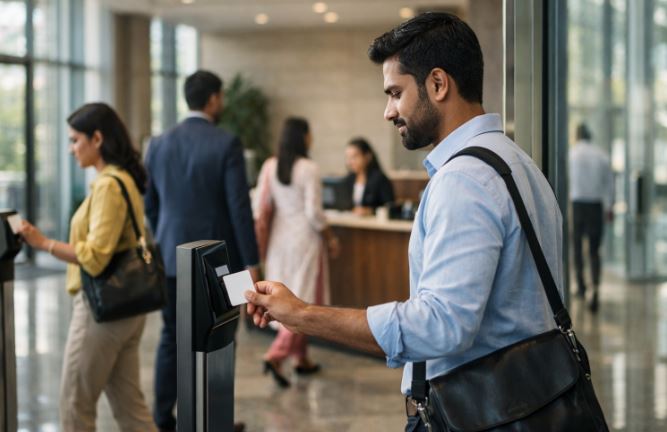
Smart card attendance systems enable quick tap-and-go functionality, allowing employees to mark attendance within seconds. This reduces queues and congestion during peak office hours, particularly in large organizations or institutions.
Faster check-ins directly translate into improved productivity, as employees spend less time waiting and more time working. Additionally, the system automates attendance tracking, report generation, and integration with HR software, saving administrative effort.
Managers gain instant access to real-time attendance data, helping them make informed decisions quickly. Overall, the streamlined process enhances workflow efficiency and reduces operational bottlenecks, making it a practical solution for modern workplaces.
3. Contactless and Hygienic Solution
In a post-pandemic world, hygiene and safety have become top priorities for organizations. Smart card based attendance systems offer a contactless solution, eliminating the need for physical touchpoints like fingerprint scanners or shared devices.
Employees simply tap their cards on a reader, ensuring minimal physical interaction. This reduces the risk of germ transmission and promotes a healthier work environment.
The contactless nature also improves user comfort and acceptance, especially in industries where hygiene standards are critical, such as healthcare, education, and manufacturing. By adopting such systems, organizations demonstrate a commitment to employee well-being while maintaining efficient attendance tracking.
4. Seamless Integration with HR and Payroll Systems
Smart card attendance systems can be easily integrated with existing HRMS and payroll software, creating a unified workforce management ecosystem. Attendance data is automatically synced, reducing manual data entry and associated errors.
This integration enables accurate salary calculations, leave management, and compliance reporting without additional effort. Organizations can also generate detailed analytics and insights on employee attendance patterns, helping in better resource planning.
The centralized system ensures that all departments have access to consistent and up-to-date information. By automating these processes, businesses can focus more on strategic tasks rather than routine administrative work, improving overall productivity.
5. Scalable and Cost-Effective Solution
As organizations grow, managing attendance manually or through outdated systems becomes increasingly complex. Smart card solutions are highly scalable and can easily accommodate an expanding workforce without major infrastructure changes.
They are also cost-effective in the long run, as they reduce administrative overhead, prevent payroll leakages, and minimize maintenance costs compared to biometric devices.
The cards themselves are durable and easy to replace if lost. Whether for a small business, educational institution, or large enterprise, smart card systems provide flexibility and adaptability. This makes them a future-ready investment that supports organizational growth while keeping operational costs under control.
Conclusion
Adopting a smart card based attendance solution is no longer just a technological upgrade but a strategic move toward efficiency and transparency. It addresses key challenges like accuracy, hygiene, and scalability while simplifying workforce management.
With seamless integration, real-time tracking, and cost benefits, organizations can significantly enhance their operational processes.
As businesses continue to evolve, investing in smart attendance systems ensures they stay ahead, maintain compliance, and create a more structured and productive work environment for employees.
FAQs
What is a smart card based attendance system?
It is a system where employees use RFID or NFC-enabled cards to mark attendance by tapping on a reader. It ensures quick and accurate tracking.
How is it better than biometric attendance systems?
Smart cards are contactless, faster, and more hygienic, avoiding issues like fingerprint errors and device wear.
Can it integrate with payroll software?
Yes, most systems integrate seamlessly with HRMS and payroll tools for automatic salary and leave calculations.
Is it suitable for small businesses?
Absolutely, it is scalable and cost-effective, making it ideal for both small and large organizations.
What happens if an employee loses their card?
The card can be easily deactivated and replaced without affecting the system or data integrity.